Guide
AI search optimization for contractors.
Contractors ask me every week whether AI search is worth their time when Google Maps still brings in most of their calls.
The direct answer: yes, and most of the work is the same work that helps you on Maps. AI search optimization for contractors means making ChatGPT, Gemini, Perplexity and Google AI Overviews able to confirm who you are, what jobs you do, where you work, and that you are licensed and insured. The sources they check for contractors are specific: your Google profile, project pages, license lookups, the BBB, manufacturer directories and sites like Houzz and Angi.
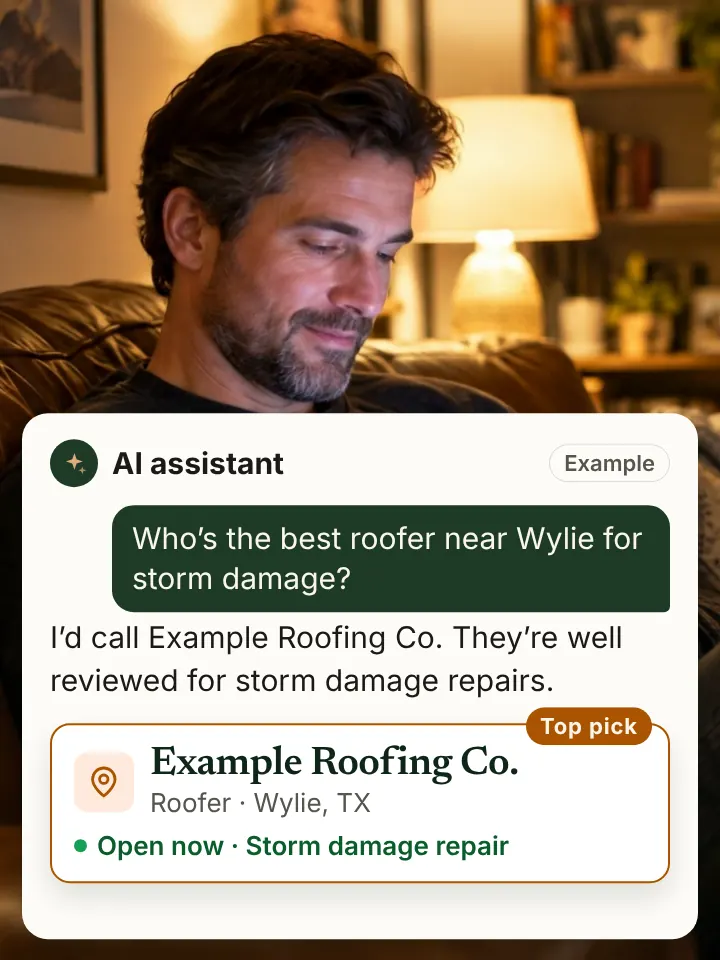
Why AI search is different for contractors
A contractor job is a big decision. Homeowners ask AI tools trust questions before they ever call: "Is this roofer licensed?" "Who is the best kitchen remodeler near Frisco?" "How do I avoid a storm chaser?" "Do I need a permit to add a circuit?"
Those questions push AI tools toward sources that can prove something: a state license record, a BBB profile, a manufacturer's certified installer list, project photos on Houzz. A contractor who is missing from those sources is hard to recommend, even with good Google reviews.
The BrightLocal Local Consumer Review Survey 2026 found 45% of consumers use ChatGPT or other AI tools for local recommendations. For high ticket jobs, those are often the people doing the most research.
Which sources do AI tools check for contractors?
| Trade | Sources that come up often | Proof AI looks for |
|---|---|---|
| Roofers | Google profile, BBB, Angi, HomeAdvisor, shingle maker certified installer lists. | Local address, years in business, storm and insurance work in reviews. |
| Remodelers | Houzz, Google profile, NARI or NAHB member listings, BBB. | Project photos and descriptions, a clear process, permits handled. |
| HVAC | Google profile, brand dealer locators, Yelp, BBB, Angi. | Brands serviced, true hours, repair versus replace guidance. |
| Electricians | Google profile, state license lookup, EV charger installer lists, Nextdoor. | License number, permit knowledge, specific jobs like panels and chargers. |
| Plumbers | Google profile, city ranking pages, plumbing directories, state license lookup. | License number, emergency hours, a page per job such as slab leaks or water heaters. |
These are the patterns I see most when I trace AI answers back to their sources. They vary by city, which is why it pays to run your own questions and look at the citations.
How each AI tool tends to behave
- ChatGPT runs web searches and leans on directories, ranking pages and contractor websites. It often adds safety advice, like "check the license before you hire."
- Google AI Overviews and Gemini lean harder on Google's own data, including your Google Business Profile and reviews.
- Perplexity shows its sources prominently, which makes it a good tool for seeing which sites are trusted in your area.
- Claude can also search the web and cite its sources.
The foundation is shared. One set of fixes helps across all of them. The general version of this guide is AI search optimization.
Urgent jobs and planned jobs need different pages
Contractors get two kinds of questions. Urgent ones, like "emergency roof tarp after storm" or "no AC repair today." Planned ones, like "best company for a full kitchen remodel" or "should I replace my 20 year old roof."
Urgent questions reward true hours, a clear service area and recent reviews. Planned questions reward detailed service pages, project examples described in words, credentials and plain answers to the research questions people ask before they call. Most contractor sites only cover one of the two.
AI search optimization for contractors, in order
- Run 10 real questions in ChatGPT for your trade and towns, urgent and planned, and note who is named and which sites are cited.
- Fix your Google Business Profile: primary category, service area, true hours, services, description and project photos.
- Publish your license, insurance and certification details on your site, matching the official records.
- Get listed on the credential sources for your trade: state license lookup, manufacturer installer directory, trade association.
- Give each job type its own page, and describe real projects in words: scope, town, what changed. Keep client names private unless they agree in writing.
- Make your name, address and phone match on Google, Bing, Apple, BBB, Angi, HomeAdvisor and Houzz.
- Add schema markup with the most specific type that fits, such as RoofingContractor, HVACBusiness, Electrician, Plumber or GeneralContractor.
- Write plain answers to trust questions: permits, insurance claims, warranties, timelines, and how to choose a contractor.
- Allow OAI-SearchBot and other AI crawlers in your robots.txt.
- Recheck the same questions monthly.
What contractors should not do
- Promise insurance claim outcomes. Explain how you work with adjusters instead.
- Copy reviews from other sites into your own review markup.
- Publish a firm timeline without the factors that change it.
- Pay anyone for a guaranteed spot in ChatGPT.
Google Maps still brings most contractor calls
The BrightLocal local AI visibility study saw Google Maps show a tracked business in 66% of local searches, against 33% for ChatGPT. Keep your Maps work going. The good news is that nearly every step above helps both.
Each trade has its own full guide on our industries page, covering the Google Maps side and the AI side together. To see where you stand today, ask for an AI visibility audit, at no cost.
Straight answers
Straight answers.
What is AI search optimization for contractors?
It is making AI tools like ChatGPT, Gemini and Google AI Overviews able to confirm who you are, what jobs you do, where you work and that you are licensed and insured, so they name you for contractor questions.
Do licenses and certifications help contractors in AI answers?
Yes. AI tools often bring up licensing on contractor questions, and credential sources like state lookups and manufacturer directories let them confirm you.
Does Houzz matter for AI search?
For remodelers and design work it often does. It is a common source for project photos and reviews in remodeling answers.
Is AI search optimization worth it if Google Maps works for me?
Most of the work overlaps with Maps, so it helps both. AI search adds a few steps, like crawler access and credential listings, that protect you as more homeowners ask AI first.