Comparison
AI SEO vs traditional SEO.
Owners ask me a version of the same question every week. Should I stop paying for SEO and switch to AI? My answer is no. You need both, and they help each other.
Here is how they compare, side by side, without the hype.
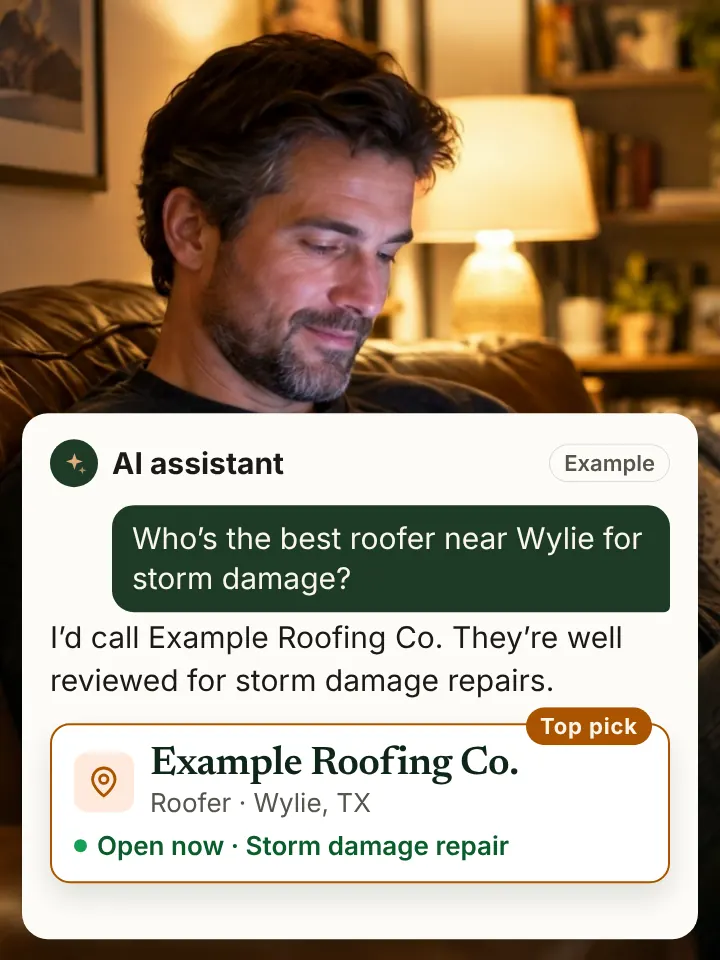
Side by side
| Traditional SEO | AI SEO | |
|---|---|---|
| What it targets | Higher positions for your pages in Google results and the map pack. | Being named in the short list an AI assistant writes. |
| What it reads | Your pages, links to your site, your Google Business Profile and reviews. | Your Google profile, website, review sites, directories and other mentions, summarized together. |
| How results are measured | Rank positions, clicks, calls from Google. | How often you are named across a set of questions, and which sources are cited. |
| How fast it changes | Fairly stable from day to day. | Can change between two asks of the same question. |
| What it rewards | Relevance, authority and local proximity. | Clear, consistent facts that several trusted sources agree on. |
Google Maps still matters
Some marketers talk as if Google is finished. The data does not say that. The BrightLocal Local Consumer Review Survey 2026 found 71% of consumers use Google Search at some point in a local search. The BrightLocal local AI visibility study saw Google Maps show a tracked business in 66% of local searches, against 33% for ChatGPT.
Google is still the bigger channel for most local trades. And your Google Business Profile is one of the main sources AI reads. Neglect it and both channels suffer.
Where the two overlap
Most of the work counts twice. A complete Google profile helps your local pack visibility and gives AI accurate facts. Matching listings build trust with Google and make your entity clear to assistants. Good service pages rank and get cited. Reviews help everywhere.
Where they differ
Traditional SEO cares a lot about links pointing to your site and about ranking for many keyword variations. AI SEO cares more about whether the facts about you line up across sources, whether your content answers questions directly, and whether AI crawlers can read your site at all.
Measurement differs too. A rank tracker can tell you where a page sits on Google. For AI, you need repeated visibility checks because each answer is generated fresh.
Why you need both
Think of it as one house with two doors. Some customers walk in through Google. Some walk in through ChatGPT. The foundation under both doors is the same: accurate information, clear pages and real reviews.
If you already pay for local SEO, keep it. Ask whoever does it whether they check AI answers too. If not, that is the gap we fill.
A sensible order of work
- Fix the Google Business Profile.
- Clean up listings so name, address and phone match.
- Strengthen service pages and add schema markup.
- Add short FAQ answers. See answer engine optimization.
- Measure both channels. Google with your usual reports, AI with scheduled checks.
For the AI side in more depth, read how to rank on ChatGPT.
Straight answers
Straight answers.
Is traditional SEO dead?
No. Google is still where most local searches happen, and Google data feeds AI answers too.
Does AI SEO replace Google Maps?
No. Google Maps remains a major channel. AI search extends local SEO rather than replacing it.
Can one company do both?
Yes. Much of the work overlaps. What changes is how you measure the AI side, with repeated checks instead of fixed ranks.
Which should I start with?
Start with your Google Business Profile and listings. They help both channels at once.