Guide
AI search optimization: one foundation, many assistants.
Your customers do not all use the same AI tool. Some ask ChatGPT. Some see a Google AI Overview without asking for one. Others use Perplexity, Gemini or Claude.
AI search optimization is the work of being visible across all of them. The good news is that you do not need a separate plan for each one.
What AI search visibility means
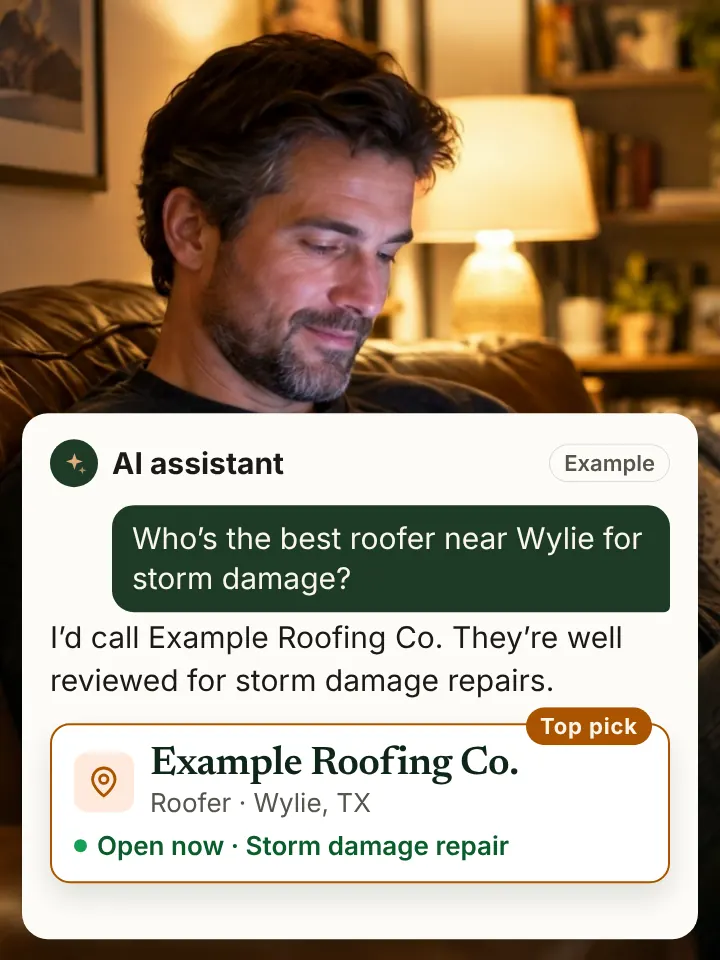
AI search is any tool that answers a question directly instead of only listing links. AI search visibility is how often your business shows up in those answers when people ask about the services you offer, where you offer them.
The BrightLocal Local Consumer Review Survey 2026 found 45% of consumers use ChatGPT or other AI tools for local business recommendations. That is a big enough share to take seriously, even while Google remains the larger channel.
The assistants your customers use
- ChatGPT. The best known assistant. With search on, it reads the live web and often cites sources.
- Google AI Overviews. Summaries that appear above regular results on many searches, built from Google's index.
- Google AI Mode. A conversational search experience inside Google for longer questions and follow ups.
- Gemini. Google's assistant, closely tied to Google's own data, including Maps and business profiles.
- Perplexity. An answer engine that shows its sources prominently.
- Claude. Anthropic's assistant, which can also search and cite the web.
- Grok. The assistant inside X, which we include in our scheduled checks.
They differ at the edges
Each tool has its own habits. Google products lean on Google's index and business profiles. Perplexity puts its citations front and center, which makes it easy to see which sites it trusts. ChatGPT and Claude can phrase things in a more conversational way and sometimes pull from different review sites.
These differences matter when we read results. They do not change the core work very much.
One foundation feeds all of them
Every one of these assistants is trying to answer the same thing: which local businesses can be trusted for this job? They answer it by reading public information. So the foundation is shared.
- A complete, correct Google Business Profile.
- A website that states your services and service area plainly, with schema markup.
- Consistent listings across directories, so your entity is clear.
- Reviews on Google and the sites customers in your trade actually use.
- Open access for AI crawlers.
- Short answers to real customer questions, written so assistants can quote them.
Build that once and keep it accurate. It works for the tools that exist today and the ones that arrive next year.
How we measure across assistants
We run the same set of buyer questions across ChatGPT, Gemini, Perplexity, Grok and Claude on a schedule. We record who is named and which sources are cited. Over months that becomes a share of voice picture you can actually read.
A single result is a snapshot. The trend is what tells you whether the work is landing.
Where to go from here
If you want the ChatGPT specific version of this, read how to rank on ChatGPT. If you are curious about the industry labels, see generative engine optimization. To see where you stand today, ask for an AI visibility audit.
Straight answers
Straight answers.
Do I need a different strategy for each AI tool?
Mostly no. The same foundation of accurate listings, clear pages, structured data and reviews feeds all of them. We watch the differences when reading results.
Are Google AI Overviews part of AI search optimization?
Yes. AI Overviews and AI Mode are AI answers inside Google, and they draw on the same kind of public information.
Which AI tools do you check?
Our scheduled checks cover ChatGPT, Gemini, Perplexity, Grok and Claude, using the same set of questions each time.
Is AI search replacing Google?
No. The BrightLocal survey found 71% of consumers still use Google Search at some point in a local search. AI search extends local SEO rather than replacing it.
What is the difference between AI search optimization and ChatGPT SEO?
ChatGPT SEO focuses on one assistant. AI search optimization covers all of them. The work underneath is largely the same.